STXBP1
c.1217G>A (p.Arg406His)
Family Summary
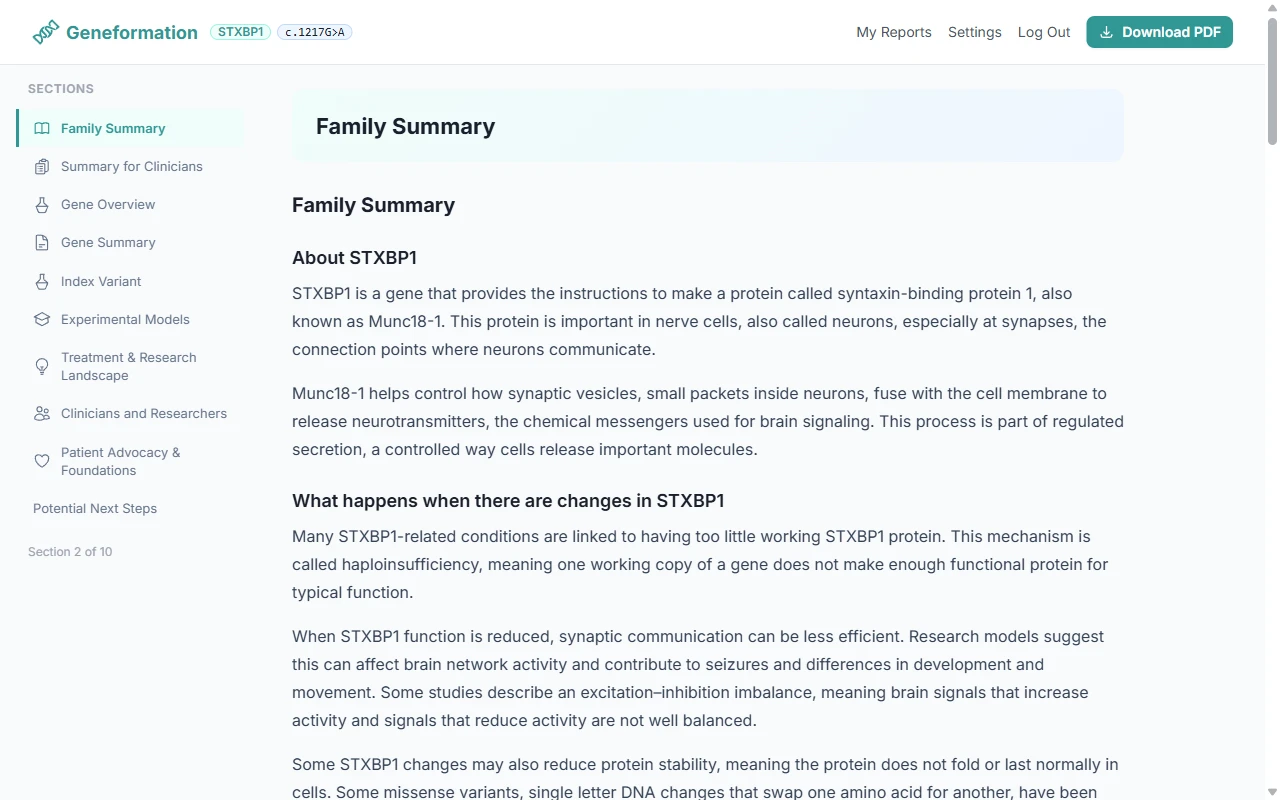
Section 1 of 10About STXBP1 — STXBP1 is a gene that tells the body how to make a protein called syntaxin-binding protein 1 (also called Munc18-1). This protein is found at the connections between nerve cells in the brain, called synapses, where messages are passed from one nerve cell to another. STXBP1 is especially active in the brain, including the cerebral cortex, and is mainly present in nerve endings where it helps control the release of chemical messengers, called neurotransmitters, between brain cells.
What happens when there are changes in STXBP1 — Changes in STXBP1 can reduce the amount of working STXBP1 protein or make the protein less stable or less able to do its job. When STXBP1 is not working properly, nerve cells have trouble releasing neurotransmitters in a normal way. This can disturb the balance between "exciting" and "calming" signals in the brain, which can affect how brain networks develop and work, and can lead to developmental delay, difficulties with movement, and seizures.
STXBP1-related conditions — Changes in one copy of the STXBP1 gene are linked to:
- STXBP1-related encephalopathy with epilepsy, a brain disorder with developmental delay and seizures.
- Developmental and epileptic encephalopathy 4 (DEE4), an early-onset epilepsy and developmental disorder.
- A broader STXBP1-related neurodevelopmental disorder spectrum.
Common features — The full Family Summary covers detailed clinical features across 9 categories:
The summary also covers inheritance, current clinical care, potential therapeutic approaches (gene therapies, ASO approaches, small molecules, symptomatic treatments), community and connections (9 advocacy organizations worldwide), 14 clinicians and researchers, and the indexed variant with functional data and variant-specific considerations.
Screenshot from the actual report dashboard:
Summary for Clinicians
Section 2 of 10Heterozygous pathogenic variant in STXBP1 (NM_003165.6:c.1217G>A, p.Arg406His) identified in a patient with developmental and epileptic encephalopathy. This missense variant affects a highly conserved residue in domain 3b of Munc18-1 and has been recurrently reported in individuals with EIEE4/DEE4 (PMID: 18950747, PMID: 26795593).
ClinVar classification: Pathogenic (review status: criteria provided, multiple submitters). Functional studies demonstrate reduced metabolic stability, increased protein aggregation, and loss of functional STXBP1. In a cohort of 534 individuals, changes at position Arg406 were seen in 40 individuals, making it a recurrent hotspot.
The full clinician summary is a concise, technical overview designed for clinical team review.
Gene Overview
Section 3 of 10Data sourced from HGNC, NCBI Gene, UniProt, ClinVar, and OMIM with direct links.
Gene Summary
Section 4 of 10Associated Disorders & Clinical Features
Pathogenic variants in STXBP1 are associated with a spectrum of neurodevelopmental disorders, collectively referred to as STXBP1-related disorders. The estimated incidence is approximately 1 in 30,000 births, making it one of the more common genetic etiologies for developmental and epileptic encephalopathies (Stamberger et al., 2016). In the largest cohort to date (534 individuals), Xian et al. (2022) showed that seizures were the most common presenting feature, with onset typically in the first year of life.
Protein Structure and Function
STXBP1 encodes the Munc18-1 protein, essential for synaptic vesicle exocytosis, acting as a template for SNARE complex assembly at presynaptic terminals. The protein adopts an arch-shaped conformation with three domains that bind syntaxin-1A in both closed and open conformations (Misura et al., 2000).
Pathomechanisms
Disease-causing STXBP1 variants operate primarily through haploinsufficiency (reduced functional protein dosage). Missense variants can additionally cause protein instability and aggregation, sometimes through a dominant-negative mechanism where mutant protein sequesters wild-type protein into non-functional aggregates.
Variant Analysis
Section 5 of 10Location & impact: This variant changes position 406 from arginine to histidine in domain 3b, a region critical for syntaxin-1A binding. In a large cohort of 534 individuals, changes at this position (Arg406His and Arg406Cys) were seen in 40 individuals, making it a recurrent hotspot.
Functional evidence: R406H protein shows reduced metabolic stability and decreased detergent solubility. The mutant protein forms aggregates and can pull normal STXBP1 protein into clumps, reducing the amount of usable protein. In a C. elegans model, the variant led to lower Munc18-1 levels. Pharmacological chaperones partially improved stability in neuronal model systems.
Variant-specific considerations: Approaches that increase protein stability or prevent aggregation may be particularly relevant to this variant's mechanism.
Experimental Models
Section 6 of 10Multiple animal and cellular models have been established to study STXBP1 function and disease mechanisms:
- Heterozygous knockout mouse models demonstrating seizure susceptibility, cognitive impairment, motor deficits, and hyperactivity.
- Patient-derived iPSC neuronal models showing reduced synaptic transmission and altered network activity.
- Humanized C. elegans models for specific variant testing, including R406H, showing reduced protein levels and synaptic dysfunction.
- Drosophila (fruit fly) models for studying conserved Munc18 function.
Potential Treatment Approaches
Section 7 of 10This report identified 24 therapeutic candidates across 4 categories:
Each therapeutic candidate includes:
- Name, type, and development stage (Phase 1/2, preclinical, FDA/EMA approved, etc.)
- Description of the approach and mechanism
- Evidence level and study design
- Variant applicability assessment (applicable for your specific variant type)
- Links to ClinicalTrials.gov, PubMed, and other original sources
Example entries from this report:
CAP-002 (Capsida Biotherapeutics)
AAV-based gene therapy for intravenous delivery to neurons. In mouse models, CAP-002 increased STXBP1 levels and improved seizures, movement problems, and learning measures in a dose-dependent way. Now being studied in children with STXBP1 encephalopathy.
Source: ClinicalTrials.gov NCT06983158
Fenfluramine
Approved antiseizure medicine affecting serotonin signaling. Being studied in STXBP1 encephalopathy. Evidence from controlled trials in other epileptic encephalopathies supports its use.
Source: ClinicalTrials.gov NCT05232630
The section also includes a Potential Therapeutic Avenues analysis specific to the gene and variant mechanism.
Screenshot from the actual report dashboard:

Clinicians & Researchers
Section 8 of 10This report identified 14 clinicians and researchers with published work related to STXBP1, organized into 3 groups:
Clinicians with published experience managing STXBP1-related epilepsy and developmental outcomes. Includes neurologists from Belgium, Denmark, USA, and Italy.
Investigators leading clinical trials, cohort studies, and translational research relevant to STXBP1. Includes researchers from USA and Netherlands.
Including the STXBP1 Foundation patient advocacy leader coordinating natural history programs.
For each person, the report includes: name, credentials, role, institutional affiliation, a narrative description of their work and contributions, links to key publications (with year and PubMed links), and profile links (institutional pages, ORCID).
Screenshot from the actual report dashboard (names blurred for privacy):

Patient Advocacy & Foundations
Section 9 of 10This report identified 9 advocacy organizations worldwide:
Each organization includes a description, website link, email contact, and social media links where available.
Screenshot from the actual report dashboard:

Potential Next Steps
Section 10 of 10Based on the findings compiled in this report, the following directions may be worth discussing with your care team:
- Genetic counseling — A genetic counselor can help interpret the variant classification and discuss implications for family members.
- Specialist referral — A pediatric neurologist or epileptologist with experience in genetic epilepsies may provide targeted management strategies.
- Clinical trial eligibility — Several active trials are recruiting for STXBP1-related conditions, including gene therapy trials. Discuss whether participation may be appropriate.
- Patient registries — Enrolling in a disease-specific registry can contribute to research and connect your family with the community.
- Advocacy organizations — Connecting with groups like the STXBP1 Foundation for support, updates, and community.
Generate a report for your gene and variant
Every report is tailored to the specific gene and variant you provide, drawing from current scientific literature and biomedical databases. Reports include all 10 sections shown above with full, unabridged content.